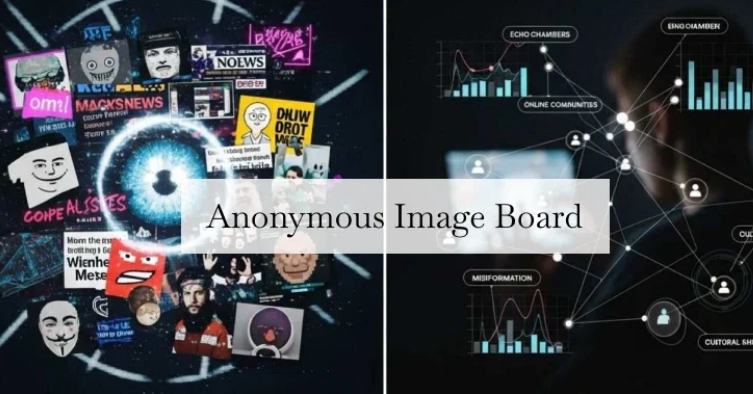
The internet is filled with profiles, verified badges, and permanent digital footprints. Yet, a completely different corner of the web operates on an entirely opposite philosophy: absolute anonymity. An anon image boards website is a platform where users can post images and text threads without ever creating an account, registering an email, or establishing an online identity.
First popularized in Japan in the late 1990s and early 2000s, these bulletin-board-style websites changed internet culture forever. They birthed iconic memes, shaped online subcultures, and pioneered hacktivist movements. However, their minimal moderation and lack of user accountability have also made them hotbeds for controversy, extreme viewpoints, and security risks.
What is an Anon Image Boards Website?
Unlike mainstream social media networks like Instagram or Reddit, an anonymous imageboard relies on an “ephemeral” and identity-free browsing experience. When you visit an anon image boards website, every user is default-named “Anonymous”. There are no follower counts, profile pictures, or historical backlogs tied to a specific individual.
Also Read: Inside Anon Image Boards Culture Safety and Truth
The mechanics of these sites are built around two core pillars:
- Image-Centric Posting: To start a new conversation thread, a user must upload an image. The image serves as the anchor for the topic, while subsequent replies can consist of text-only comments or additional files.
- The “Bump” System: Threads are entirely temporary. When someone replies to a thread, it gets “bumped” to the top of the board. If a thread stops receiving engagement, it drops down the pages and is permanently deleted to make room for new content.
This creates a fast-moving, hyper-current stream of consciousness that values the content of a post over the person who posted it.
The Core Ecosystem of Popular Imageboards
While hundreds of minor boards exist across the clear web and dark web, a few major platforms define the global landscape.
| Platform | Launch Year | Core Audience / Focus | Key Distinction |
| 4chan | 2003 | Global internet culture, anime, gaming, politics | The most influential and visited English imageboard. |
| 8kun (Formerly 8chan) | 2013 | Extreme free speech, fringe subcultures | Allows users to build custom, user-moderated boards. |
| Dvach (2ch.hk) | 2009 | Russian-speaking web culture | The largest regional, non-English imageboard online. |
| 420chan | 2005 | Cannabis culture, drug harm reduction | Focuses heavily on specific subcultures and alternative lifestyles. |
4chan: The Blueprint of Western Imageboards
Launched in 2003 by Christopher Poole, 4chan was built to mimic the Japanese text and imageboard format (specifically Futaba Channel). It is divided into dozens of specific boards dedicated to distinct interests, labeled with letters like /v/ (Video Games), /lit/ (Literature), and the infamous /b/ (Random). Over the years, 4chan has driven the global adoption of massive internet phenomena, while simultaneously drawing immense scrutiny from global media and law enforcement.
8kun: The Decentralized Radical Alternative
Originally known as 8chan, this site emerged as an alternative for users who felt 4chan’s moderation had become too strict. Its defining feature is that anyone can create an independent board on any topic. Because of its radically hands-off approach to moderation, it has faced extreme pushback, including domain bans, server blacklists, and service denials from major internet infrastructure providers.
Navigating Imageboard Culture and Vocabulary
Stepping onto an anon image boards website for the first time can feel like visiting a foreign country without a dictionary. The combination of total anonymity and multi-decade histories has fostered a highly insular vocabulary.
Essential Terms to Know
- OP (Original Poster): The person who initiated the specific thread.
- Anons: The collective term used to describe the user base of these sites.
- Lurk More: A universal rule of advice given to newcomers. It means you should silently read and observe a board’s culture for weeks before attempting to post, avoiding social faux pas.
- Tripcode: An optional piece of cryptographic text generation that allows an anonymous user to prove their identity across multiple posts without registering a permanent account.
- Raids: Coordinated, mass actions taken by users across multiple threads or external platforms to shock, prank, or disrupt target websites.
The Hidden Risks: Safety, Privacy, and Content Warnings
While the concept of a pure, identity-free town square sounds liberating, the reality of an anon image boards website requires extreme caution. These spaces are inherently unpredictable and are not designed for casual, sensitive, or underage audiences.
1. Exposure to Explicit and Graphic Content
Because moderation on boards like /b/ or /pol/ is exceptionally sparse, users frequently post graphic violence, adult content, hate speech, and shock media. Even if you browse boards dedicated to safe topics like cooking or technology, bad actors can “cross-post” harmful imagery to disrupt the community.
2. Cybersecurity Threats
Imageboards are high-risk zones for malicious links, phishing scams, and malware distribution. Unwary users who download images or click shortened URLs embedded in threads risk infecting their devices. Advanced imageboard browsers, like the open-source Android project KurobaEx, offer sandbox mechanics to mitigate some browser-level exploits, but personal vigilance remains vital.
3. Doxxing and Targeted Harassment
Absolute anonymity works both ways. While it protects your true identity, it also removes empathy from bad actors. If a user accidentally leaves a identifying detail in an uploaded file—such as location metadata (EXIF data) embedded in a photo—other users may weaponize that data to launch real-world harassment campaigns, a practice known as doxxing.
Conclusion
An anon image boards website is a raw look into the unfiltered internet. It represents a living archive of digital folklore, demonstrating how communities self-organize when profiles, algorithmic feeds, and corporatized metrics are entirely stripped away.
However, that exact freedom strips away the guardrails that keep modern internet spaces safe. If you choose to explore an anonymous imageboard, always remember the golden rules of the landscape: lurk first, safeguard your personal details, never click unverified links, and prioritize your digital safety above curiosity.
FAQs
Are anonymous imageboards illegal to visit?
No, browsing a public anon image boards website is completely legal. However, because these platforms feature minimal moderation, illegal content can occasionally appear before administrators can delete it. Possessing or downloading illegal materials found on these platforms carries severe legal penalties.
Why do people prefer imageboards over platforms like Reddit?
Many users value the fact that ideas stand completely on their own merits. On standard forums, user history, upvote scores, and public clout heavily influence how a comment is perceived. On an anonymous imageboard, every post starts on an equal playing field.
Can you be tracked on an anonymous imageboard?
Yes. While you are anonymous to other users on the front end, your IP address is still logged by the website’s servers and visible to network administrators. Law enforcement agencies routinely issue subpoenas to imageboards to track down individuals engaging in malicious or illegal behavior online.
How do imageboard administrators keep their sites funded?
Because mainstream brands refuse to display advertisements next to unmoderated content, funding is notoriously difficult. Most platforms survive on alternative advertising networks, cryptocurrency donations, or premium subscription models (like the “4chan Pass”) that let users skip security verifications.
For more updates visit: Connections Hint