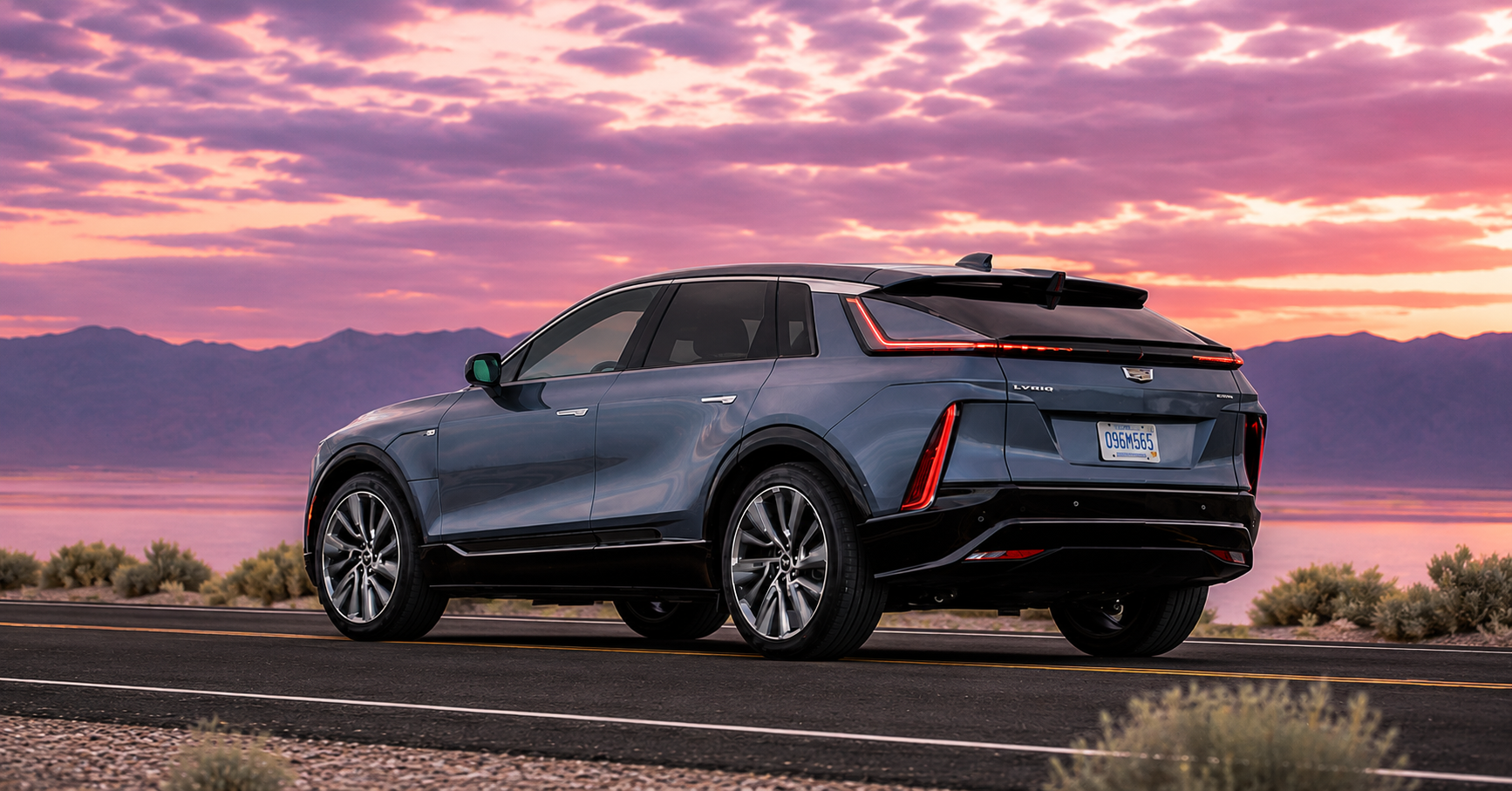
You just picked up your Lyriq, and the little “Tour / Sport / Snow-Ice” selector on the console is staring at you. Does flipping that switch actually change how far you’ll get on a charge, or is it just for show?
Short answer: yes, the modes change your range, but not because they touch the battery itself. They change how aggressively the car uses the energy that’s already sitting in the pack. Once you understand that distinction, the rest of the puzzle falls into place fast.
This guide walks through exactly what each mode does, how much range difference you can realistically expect, and what actually matters more than the mode you pick.
What Changes and What Doesn’t
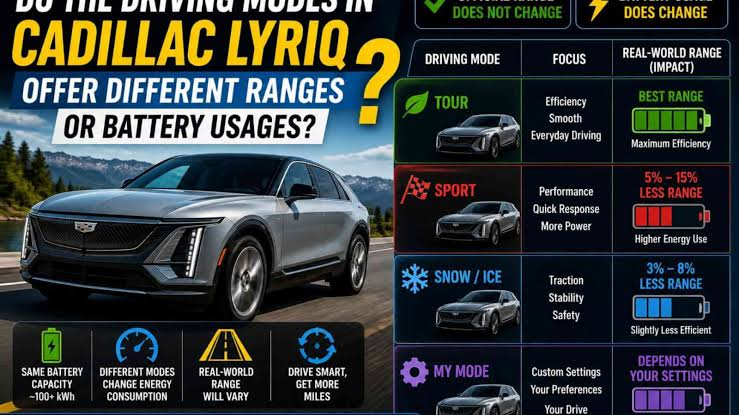
Every Cadillac Lyriq, regardless of trim, runs on the same 102 kWh Ultium battery pack. Selecting a driving mode does not add or remove capacity from that pack — the physical battery size is fixed the moment the car leaves the factory.
What the mode selector does change is how quickly that stored energy gets used:
- Throttle mapping (how sensitive the pedal is)
- Regenerative braking strength
- Steering weight
- Traction control behavior
- In some modes, climate and sound profile
Since faster acceleration and higher power draws pull more current from the battery per mile, the practical result is a real, measurable difference in how far you can drive — even though the battery’s total energy never changes.
Cadillac Lyriq Driving Modes at a Glance
| Mode | Focus | Typical Range Impact |
|---|---|---|
| Tour | Comfort, efficiency, daily driving | Closest to EPA-rated range |
| Sport | Quicker throttle, firmer steering | Roughly 10–20% less range |
| Snow/Ice | Traction and stability | Slightly reduced, varies with conditions |
| My Mode | Fully customizable | Depends on your chosen settings |
| Velocity Max (Lyriq-V only) | Maximum performance bursts | Noticeably reduced during use |
Note: Cadillac has not published an official mode-by-mode range rating. The figures above reflect patterns reported by owners, journalists, and independent EV testing rather than a factory spec sheet.
Tour Mode: The Efficiency Default
Tour is where the Lyriq starts every time you get in, and it’s tuned to strike a balance rather than chase a specific extreme. Throttle response ramps up gradually instead of snapping to full power, regenerative braking runs at a stronger baseline setting, and the steering stays light and easy.
For daily commuting, errands, and long highway stretches, Tour mode is generally the setting that gets you closest to the EPA numbers Cadillac advertises — up to roughly 314–326 miles on the rear-wheel-drive Lyriq and around 307–319 miles on the all-wheel-drive version, depending on model year and wheel size. If maximizing range is your priority, this is the mode to leave selected.
Sport Mode: Performance Has a Cost
Sport mode sharpens everything. A light tap of the pedal now commands a much bigger torque request, steering firms up for a more connected feel, and regenerative braking typically eases off so the car coasts more like a traditional performance vehicle.
That responsiveness is genuinely fun in a 5,500-pound SUV that can move — but it comes directly out of the battery. Rapid, high-torque acceleration events are one of the single biggest drains on any EV battery, and Sport mode invites more of them by design.
Real-world reports from owners and reviewers generally put the range reduction somewhere in the 10% to 20% range compared to Tour mode, depending on how aggressively the mode is actually driven. Someone who selects Sport but still drives gently won’t see nearly the same hit as someone who uses every bit of that instant torque.
Snow/Ice Mode: Safety Over Efficiency
Snow/Ice mode isn’t built around saving energy — it’s built around keeping the tires from spinning on slick surfaces. Power gets metered out more gradually regardless of pedal input, and traction control works harder in the background to manage grip.
The range effect here is usually modest, not dramatic. The bigger factor in winter isn’t the mode at all — it’s cold temperatures. Battery chemistry becomes less efficient in the cold, and the thermal management system has to spend energy keeping the pack in its optimal operating range, plus cabin heating pulls from the same battery. Most of what feels like “Snow/Ice mode range loss” is really seasonal range loss that would happen in Tour mode too.
My Mode: You’re in Control
My Mode lets you mix and match instead of accepting a preset. You could pair Tour-level throttle response with firmer steering, or blend Sport-style acceleration with stronger regenerative braking — whatever combination fits how you actually drive.
Because of that flexibility, the range outcome is entirely up to your settings. A driver who dials in gentle throttle mapping and maximum regen in My Mode can realistically match or even beat Tour mode’s efficiency, while a driver who leans toward performance settings will see a hit similar to Sport mode.
What Matters More Than the Mode Itself
It’s worth being honest here: driving mode is one input among several, and it’s often not the biggest one. These factors tend to move the needle more than the mode selector alone:
- Speed — aerodynamic drag increases sharply above 65 mph, in any mode
- Cold weather — battery efficiency and cabin heating both take a toll
- Wheel size — larger wheels (like 22-inch options) increase rolling resistance
- Climate control use — running the heater or AC hard pulls straight from the pack
- Driving style — smooth, gradual acceleration helps regardless of which mode is active
- Terrain — hills and stop-and-go traffic change how much energy regen can recover
A disciplined driver in Sport mode can still out-range an aggressive driver in Tour mode. The mode sets the ceiling for efficiency, but your habits behind the wheel decide how close you actually get to it.
Practical Tips to Stretch Your Range
- Default to Tour mode for daily commuting and road trips
- Use One-Pedal Driving or the Regen on Demand paddle to recover more energy while slowing down
- Precondition the cabin while still plugged in during cold weather, rather than heating it after unplugging
- Save Sport mode for shorter drives where the fun factor outweighs the mileage
- Keep highway speeds moderate — drag costs more range than most drivers expect
- If range is your top priority, try building an efficiency-focused custom profile in My Mode
Final Thoughts
Do the driving modes in Cadillac Lyriq offer different ranges or battery usages? Yes — but it comes down to how energy is delivered and recovered, not how much energy the battery holds. Tour mode plays it efficient, Sport mode trades range for responsiveness, Snow/Ice prioritizes safety over mileage, and My Mode leaves the outcome in your hands. Understanding that distinction turns a confusing dashboard button into a genuinely useful tool for getting the most out of every charge.
Also Read: Fix Slow WiFi at Home 9 Quick Ways to Boost Your Speed
FAQs
Does switching driving modes on the Cadillac Lyriq change the battery’s capacity?
The 102 kWh battery pack stays the same size no matter which mode you select. Modes only change how quickly that stored energy is used.
Which Lyriq driving mode gives the best range?
Tour mode generally delivers the range closest to Cadillac’s EPA estimates, thanks to smoother throttle mapping and stronger regenerative braking.
How much range do you lose in Sport mode?
Real-world reports suggest a reduction of roughly 10% to 20% compared to Tour mode, depending on how aggressively you drive.
Does Snow/Ice mode use more battery?
It can use slightly more energy due to how it manages traction, but the bigger range loss in winter usually comes from cold temperatures and cabin heating rather than the mode itself.
Can My Mode be more efficient than Tour mode?
if you configure it with gentle throttle response and maximum regenerative braking, My Mode can match or slightly exceed Tour mode’s efficiency.
Has Cadillac published official range numbers for each driving mode?
Cadillac only publishes an overall EPA-rated range per trim. Mode-specific figures come from owner reports and independent testing, not factory specifications.
For more updates visit: Connections Hint