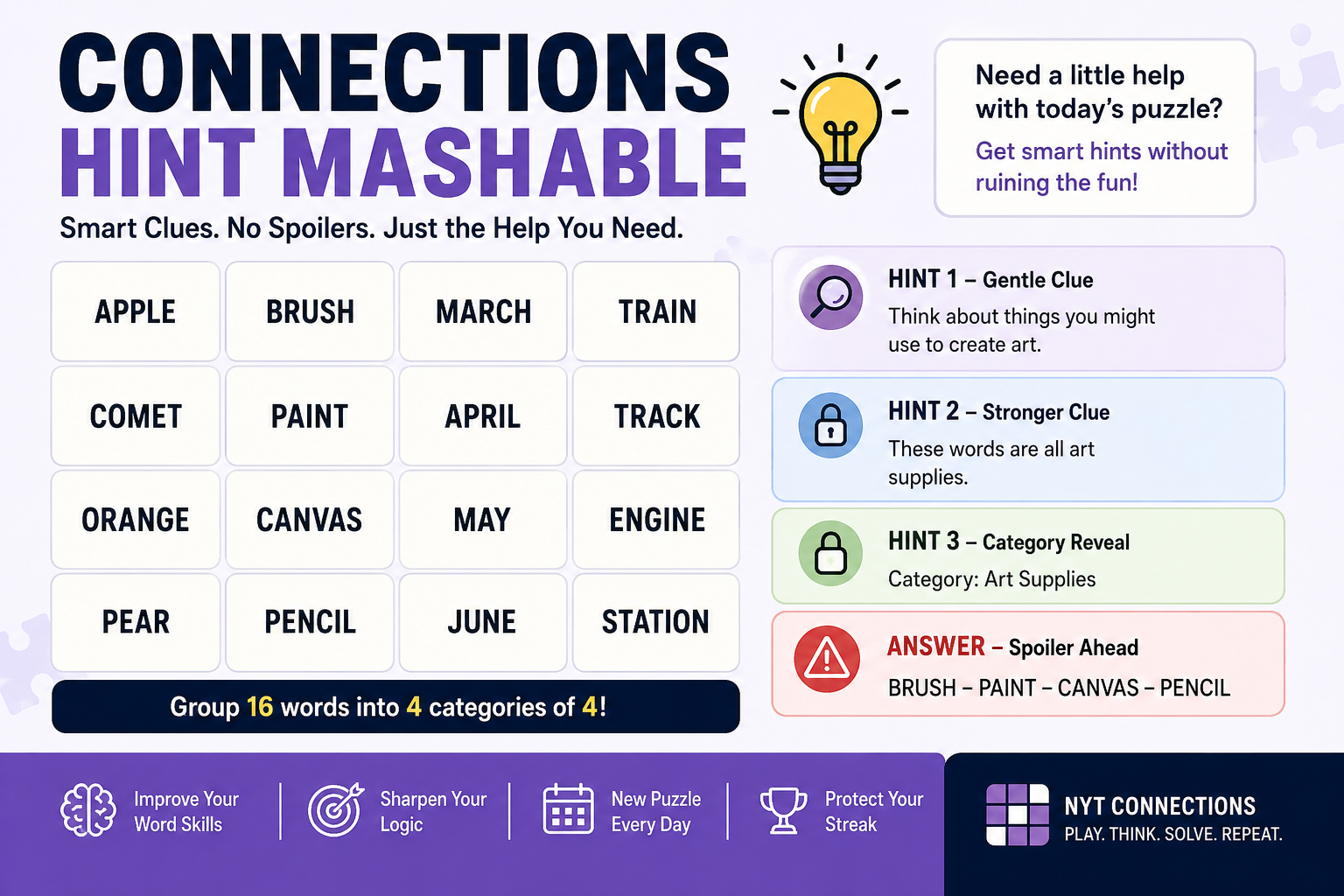
One word looks like it belongs in three different groups. Another seems too obvious. The purple category feels like it was written by someone who enjoys watching people suffer politely over coffee.
That is exactly why so many players search for connections hint mashable. They do not always want the full answer. Most of the time, they want a small push that keeps the game fun.
This guide explains what the search means, why players rely on Mashable-style hints, how NYT Connections works, and how to use hints without ruining the challenge.
What Does “Connections Hint Mashable” Mean?
The phrase connections hint mashable usually refers to people looking for Mashable’s daily clue-style coverage of the New York Times Connections puzzle.
NYT Connections is a daily word puzzle where players sort 16 words into four groups of four. Each group shares a hidden connection. Some categories are simple, such as types of fruit or colors. Others are much harder and may involve slang, pop culture, word endings, missing phrases, or double meanings.
Mashable-style hint articles became popular because they often give readers a gentle path toward the answer. Instead of immediately spoiling everything, they may offer:
- A light clue for each category
- A stronger clue if you are still stuck
- The final answers lower down the page
- A warning before spoilers appear
- A quick explanation of why the categories work
That format fits the way puzzle players actually behave. Many people want to protect their streak, but they still want to feel like they solved the puzzle themselves.
Why This Keyword Is So Popular
People search this phrase because Connections is simple to understand but surprisingly hard to master.
The puzzle looks easy: just group related words. But the challenge comes from how flexible language can be. A single word may have several meanings. A category may not be literal. Four words may look connected, but one of them might be a trap.
For example, a puzzle could include words that seem related to animals, music, food, sports, or movies. But the real category might be “words that come after ‘star’” or “terms used in card games.” That twist is what makes the game addictive.
Players often search for hints when they are in one of these situations:
- They found two or three words in a group but cannot find the fourth.
- They already made two or three wrong guesses.
- They suspect a category uses wordplay.
- They want a spoiler-free nudge.
- They want to confirm a guess before submitting.
- They do not want to lose their daily streak.
This is why hint-based pages often perform well in search. The need is urgent, daily, and clear.
How NYT Connections Works
Here is the basic structure:
| Feature | How It Works |
|---|---|
| Words | 16 words appear in a grid |
| Goal | Sort them into four groups |
| Group size | Each group has four words |
| Mistakes allowed | Players can make a limited number of wrong guesses |
| Difficulty | Groups are commonly shown from easier to harder |
| Main challenge | Finding hidden themes, not just obvious meanings |
The puzzle rewards pattern recognition. It also rewards patience. The best players do not rush to submit the first possible group they see.
Why Mashable-Style Hints Work So Well
A good hint article does not simply dump the answers at the top. It respects the player’s experience.
The best hint format works like a staircase:
1. Start With a Soft Clue
A soft clue points you in the right direction without revealing the category.
Example:
“Think about words you might hear in a kitchen.”
This helps the player look again without giving away the answer.
2. Give Category-Level Direction
A stronger clue might say:
“These four words are all cooking actions.”
Now the player has a clearer path but still needs to solve.
3. Reveal the Category Name
If the reader is still stuck, the article may reveal the group theme.
Example:
“Ways to prepare food.”
4. Show the Final Answer
Only at the end should the article list the exact four words.
This layered format is helpful because different readers want different levels of assistance. Some want a tiny clue. Others want the full solution quickly.
How to Use Connections Hints Without Spoiling the Game
The smartest way to use a hint is to stop reading as soon as you get unstuck.
Do not scroll straight to the answer unless you truly want it. Try this method instead:
- Read only the first clue.
- Return to the puzzle and test your thinking.
- If you are still stuck, read the next clue.
- Avoid the answer section until you have made your best attempt.
- After solving, read the explanation to improve for tomorrow.
This keeps the puzzle satisfying. You still get help, but you do not remove the challenge.
Common Types of Connections Categories
Understanding common category styles makes the puzzle easier over time.
Straightforward Categories
These are the easiest groups. They often involve clear lists.
Examples:
- Types of trees
- Colors
- Sports equipment
- Kitchen tools
- Dog breeds
These are usually the groups players find first.
Synonym Categories
These groups contain words with similar meanings.
Examples:
- Words meaning “small”
- Words meaning “angry”
- Words meaning “fast”
- Words meaning “talk”
These can be tricky when one word has a second meaning.
Fill-in-the-Blank Categories
These are common in harder puzzles. Each word may complete a phrase.
Example pattern:
- ___ cake
- ___ ball
- ___ light
- ___ house
The words may not seem related until you realize they all pair with the same missing word.
Pop Culture Categories
Some puzzles use names, movies, songs, TV shows, celebrities, brands, or fictional characters.
These categories can be easy for fans and confusing for everyone else.
Wordplay Categories
These are often the hardest. They may involve:
- Homophones
- Letter changes
- Hidden words
- Prefixes
- Suffixes
- Abbreviations
- Words inside other words
- Phrases with missing parts
This is where many players search for connections hint mashable because the answer can feel impossible until someone points out the trick.
Best Strategy for Solving NYT Connections
A good strategy can reduce your need for hints.
Start With the Most Obvious Group
Look for four words that clearly belong together. If you see five possible words, wait. The extra word may be a trap.
Watch for Words With Multiple Meanings
Words like “seal,” “pitch,” “date,” “spring,” “jam,” and “match” can point in several directions. These are often used to mislead you.
Do Not Submit Too Early
Finding three related words is not enough. Before submitting, ask yourself:
“Could one of these words belong somewhere else?”
If yes, keep checking.
Use the Shuffle Button
Changing the order can help your brain notice patterns. Sometimes the grid layout accidentally hides a group.
Think Beyond Literal Meaning
Connections often rewards flexible thinking. A word may be part of a phrase, a sound, a brand, a title, or a hidden pattern.
Save the Weird Words for Later
If one or two words feel unusual, they may belong to the harder blue or purple category. Do not panic. Solve the easier groups first.
Mashable vs Other Connections Hint Sites
Many websites publish daily Connections hints, but readers choose based on style.
| Site Style | Best For | Possible Downside |
| Spoiler-free hint pages | Players who want a nudge | May not help enough |
| Full answer pages | Players who are stuck | Can ruin the puzzle quickly |
| Commentary-style guides | Readers who enjoy explanation | May include extra scrolling |
| Simple answer lists | Fast checking | Less useful for learning |
| Strategy guides | Long-term improvement | Not always updated daily |
Mashable-style coverage works best when it balances help and restraint. Readers do not want a wall of filler before the clue. They want clean hints, spoiler warnings, and quick answers when needed.
Search Intent Behind This Keyword
The search intent is mostly informational and time-sensitive.
People searching this phrase are usually asking one of three things:
- “Where can I find today’s Mashable Connections hint?”
- “Can I get a clue without seeing the full answer?”
- “How do Mashable-style Connections hints work?”
A strong article should answer all three quickly. It should not pretend to provide today’s exact puzzle unless it is updated daily. If the article is evergreen, it should explain the hint system, solving strategy, and where daily freshness matters.
Content Gap in Many Competitor Articles
Many competitor pages have the same weakness: they focus only on today’s answers.
That works for daily traffic, but it becomes outdated fast. A better article should also explain:
- How to read hints properly
- How to avoid spoilers
- Why the puzzle is difficult
- What category types appear often
- How to improve without relying on answers
- Why some hints are better than others
- What information must be updated daily
This gives the page long-term value instead of being useful for only one day.
Should You Use Hints Every Day?
There is nothing wrong with using hints. Word games are meant to be enjoyable.
But if you want to get better, use hints carefully. Treat them as training wheels, not a replacement for thinking.
A good rule:
- Use no hint for the first five minutes.
- Use a soft hint if you are stuck.
- Use a stronger hint after two wrong guesses.
- Check the full answer only at the end.
This approach protects the fun and helps you learn.
What Makes a Good Connections Hint Page?
A helpful hint page should be clear, honest, and easy to scan.
It should include:
- Today’s date and puzzle number if giving daily clues
- Spoiler warnings before answers
- Hints before solutions
- Clean formatting
- Category explanations
- No fake claims
- No unnecessary filler
- A quick “how to play” section for beginners
For Google Search and AI Overviews, the content should also answer the main question directly near the top. Readers should not have to scroll through long introductions just to understand what the page is about.
Is Mashable the Official Source for Connections?
No. Connections is a New York Times game. Mashable and other publishers provide coverage, hints, commentary, and answers, but they are not the official puzzle owner.
That distinction matters. If you want to play the puzzle, go to NYT Games. If you want hints, Mashable-style articles and other puzzle guides can help.
Final Thoughts
The popularity of connections hint mashable shows something important about modern puzzle players: they do not just want answers. They want the right amount of help.
Connections is fun because it makes simple words feel tricky. A good hint keeps that fun alive. It gives you direction, protects your streak, and teaches you how to spot patterns faster next time.
Use hints when you need them, but do not rush straight to the solution. The best moment in Connections is still the one where the hidden pattern finally clicks.
FAQs
What is Connections Hint Mashable?
It refers to people searching for Mashable-style hints for the NYT Connections puzzle. These hints usually help players identify the daily word groups without immediately revealing all the answers.
Does Mashable give full Connections answers?
Mashable-style puzzle pages often include hints first and answers later. The exact format may vary, but most hint pages separate clues from spoilers so readers can choose how much help they want.
Is NYT Connections free to play?
NYT Connections is available through NYT Games. Availability and access details can change, so readers should check the official NYT Games page for the latest playing options.
How many groups are in Connections?
The puzzle has four groups. Each group contains four words that share a common theme, phrase pattern, meaning, or hidden relationship.
Why is the purple category so hard?
The purple group often uses the trickiest logic. It may depend on wordplay, phrase endings, pop culture, abbreviations, or unusual meanings rather than obvious categories.
How can I get better at Connections?
Start with obvious groups, avoid rushing guesses, watch for double meanings, shuffle the board, and study the final explanations after each puzzle. Over time, you will recognize common category patterns faster.
For more updates visit: Connections Hint