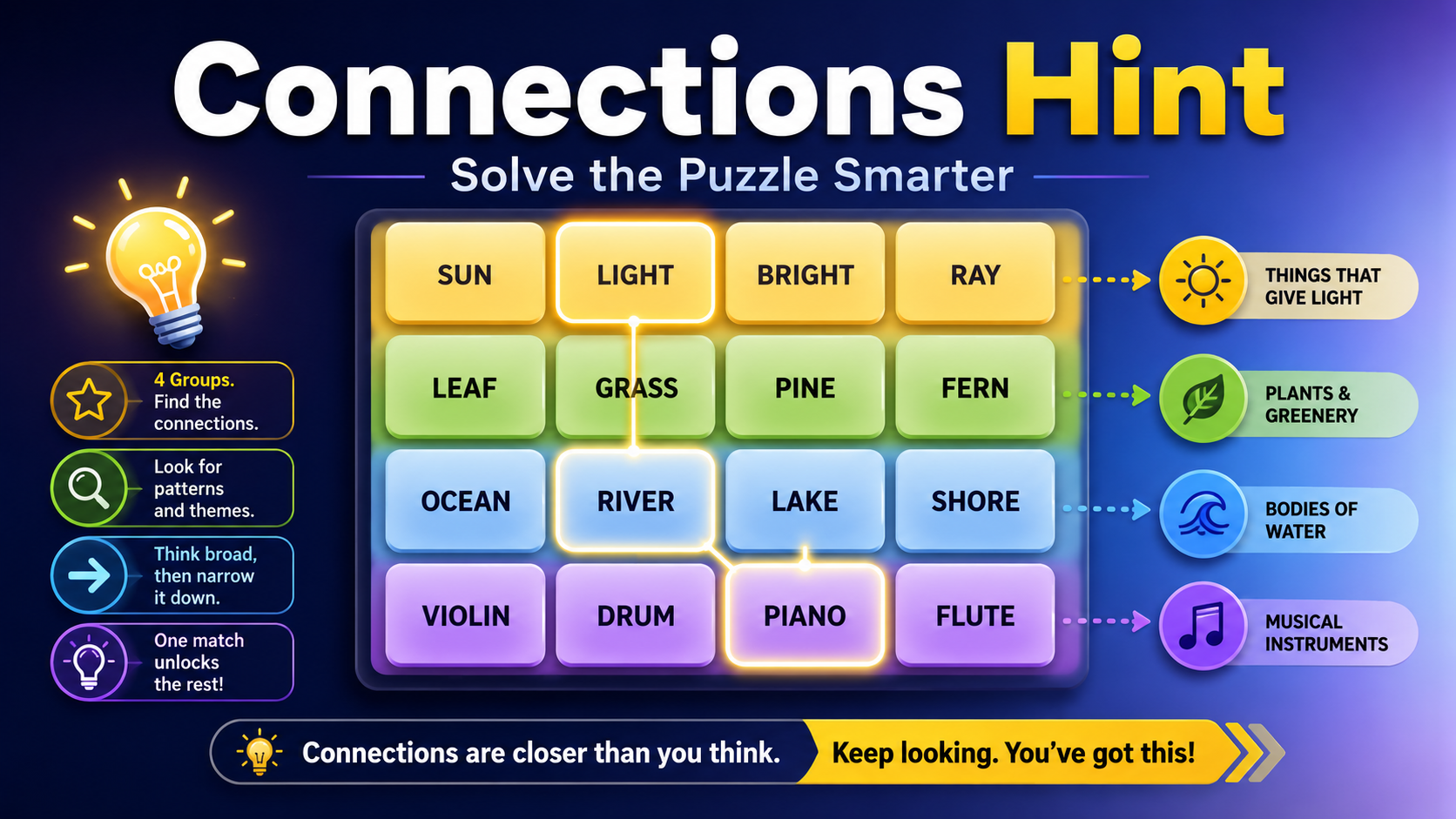
That is exactly why so many players search for a connections hint before using up all four mistakes. The New York Times Connections game looks simple at first: sixteen words, four groups, one hidden logic. But the real challenge is not knowing vocabulary. It is spotting the right relationship before a fake one pulls you in.
This guide explains what a good hint should do, how Connections works, how to read clue patterns, and how to improve your solving skills without instantly spoiling the answer.
What Is Connections?
Connections is a daily word puzzle where players sort sixteen words into four groups of four. Each group shares a common theme. The theme can be obvious, playful, cultural, linguistic, or extremely tricky.
For example, a group might include:
- Types of cheese
- Words that come before “board”
- Famous movie characters
- Homophones
- Words with silent letters
The game becomes difficult because several words may seem connected at the same time. One word can look like it belongs in one category but actually fits another. That is where careful thinking matters.
What Does a Connections Hint Mean?
A connections hint is a clue that helps you move closer to the correct group without giving away the full answer immediately.
A good hint should not simply reveal the category. It should guide your thinking. For example, instead of saying “these are pasta types,” a better hint might say “think Italian food.” That keeps the puzzle fun while giving your brain a useful direction.
Many players prefer hints because they want help, not spoilers. They still want the satisfaction of solving the puzzle themselves.
Why Players Search for Hints
Most people do not search for hints because they are lazy. They search because Connections can be genuinely deceptive.
Players usually need help when:
- Two possible groups overlap
- The purple category feels too abstract
- A word has more than one meaning
- Pop culture references are unfamiliar
- The puzzle includes wordplay
- They are one mistake away from losing
The best hint pages understand this. They do not just dump the answers at the top. They give gradual help: general clue first, stronger clue next, answer last.
How the Difficulty Colors Work
Connections uses color-coded categories after you solve each group. These colors show the usual difficulty level.
| Color | Usual Difficulty | What It Often Means |
|---|---|---|
| Yellow | Easy | Direct category or common meaning |
| Green | Medium | Slightly less obvious relationship |
| Blue | Hard | Pop culture, specific knowledge, or word pattern |
| Purple | Tricky | Wordplay, hidden meanings, puns, or phrase endings |
Do not assume yellow will always be obvious or purple will always be impossible. Some days feel easier than others. But the color system helps you understand why a group may have been harder after you solve it.
How to Use Hints Without Spoiling the Game
The smartest way to use a hint is step by step.
First, look at all sixteen words and remove the most obvious group you can find. Do not submit too quickly. Write the possible group in your head and check whether a fifth word also fits.
Second, use a light hint only when you are stuck. A light clue should point toward a broad topic, such as “music,” “sports,” “kitchen items,” or “things with wings.”
Third, avoid reading the full answer unless you are truly stuck. Once you see the answer, the puzzle loses its main reward.
A useful hint should feel like a nudge, not a shortcut.
Common Types of Connections Categories
Connections puzzles repeat certain styles. Learning these patterns can make you much faster.
1. Straight Category Groups
These are the easiest. The words share a clear topic.
Examples:
- Fruits
- Dog breeds
- School subjects
- Board games
- Weather terms
When you see four words from the same real-world category, check if they form a clean set.
2. Words Before or After Another Word
This is one of the most common tricks.
For example, words may all come before “stone,” like:
- Moon
- Gem
- Corner
- Milestone
Or they may all come after “light,” like:
- Bulb
- House
- Speed
- Year
These categories are tricky because the words may not look related until you add the missing word.
3. Multiple Meanings
Connections often uses words that have more than one meaning.
“Pitch” can mean a sports field, a sales presentation, a musical tone, or throwing a ball. “Seal” can be an animal, a stamp, or an action.
When a word feels too simple, ask yourself: “What else can this mean?”
4. Pop Culture Groups
Some groups depend on movies, music, books, TV shows, celebrities, or brands. These can be difficult if the reference is outside your knowledge.
Examples might include:
- Film titles
- Band names
- Fictional characters
- Sitcom families
- Famous directors
If four words feel random but familiar, consider entertainment or culture.
5. Wordplay and Sound-Based Groups
Purple categories often use wordplay. These may involve:
- Rhyming words
- Homophones
- Silent letters
- Words missing a letter
- Words that sound like letters
- Hidden words inside longer words
This is where many players lose. The answer may not be about meaning at all. It may be about sound, spelling, or structure.
A Smart Solving Method
Here is a simple method that works better than guessing.
Step 1: Scan for Obvious Sets
Look for four words that clearly belong together. Do not submit yet. Just mark them mentally.
Step 2: Find the Trap Words
If five words seem connected, one is probably a trap. Connections often places decoy words to make you rush.
Ask:
- Does this word fit the category perfectly?
- Is there another word that fits better?
- Could this word belong to a different group?
Step 3: Sort by Meaning First
Start with basic meanings before moving to wordplay. Most puzzles include at least one direct category.
Step 4: Think in Phrases
Try adding common words before or after each option. This often reveals hidden groups.
For example:
- “paper ___”
- “___ ball”
- “black ___”
- “___ line”
Step 5: Save the Weirdest Words
Odd words often belong to the hardest group. If a word looks out of place, do not ignore it. It may be the key to the purple category.
Good Hint vs Bad Hint
Not every hint is useful. Some pages reveal too much too quickly, while others are too vague to help.
| Hint Type | Example | Helpful? |
| Too vague | “Think carefully” | No |
| Too direct | “The answer is types of fish” | Spoiler |
| Balanced | “Think about things found in the ocean” | Yes |
| Stronger hint | “These are living things from the sea” | Yes, if needed |
The best structure is: light clue, category clue, then answer. That gives readers control.
Why Connections Feels Harder Than Wordle
Wordle is mostly about letters. Connections is about relationships.
That makes it more flexible but also more confusing. You may know every word and still miss the category. The puzzle tests pattern recognition, vocabulary, general knowledge, and lateral thinking at the same time.
Wordle usually has one path forward. Connections may show several possible paths, and some are intentionally wrong.
That is why hints are so popular. They help players escape one mental track and see another possibility.
Mistakes to Avoid
Many players lose because they rush. Here are the biggest mistakes:
- Submitting the first group that looks right
- Ignoring double meanings
- Forgetting about phrase-based categories
- Treating every category as a normal topic
- Using guesses too early
- Not checking for decoy words
- Saving all hard words until the end without thinking
A better habit is to pause before each submission. If you cannot explain the exact connection between all four words, wait.
How to Improve Over Time
You can get better at Connections with practice. The trick is to review the answer after each game and ask why you missed it.
Pay attention to:
- The category style
- The misleading words
- The hardest group
- Any wordplay pattern
- The mistake that fooled you
Over time, you will start recognizing common puzzle logic. You will notice when a word is probably being used in a second meaning. You will also become more careful with obvious-looking groups.
Should You Read the Full Answer?
There is nothing wrong with reading the answer if you are stuck. Games are meant to be enjoyable, not stressful.
But if you want to improve, try this order:
- Solve without help
- Use a light clue
- Use a stronger clue
- Reveal one category
- Read the full answer only at the end
This keeps the puzzle challenging while still giving you support.
Why Helpful Hint Content Matters in 2026
Search results are changing. Google now rewards content that gives users quick, useful answers while still offering real value beyond the first paragraph.
For a puzzle topic like this, readers do not want a long generic introduction. They want clear help, spoiler control, smart structure, and practical solving tips.
That means a strong article should:
- Explain the game clearly
- Answer the search intent fast
- Avoid keyword stuffing
- Use clean headings
- Include useful examples
- Separate hints from spoilers
- Give real solving advice
- Stay updated for daily puzzle changes
Thin pages that only repeat the answer without explanation are less useful. A better page helps readers become better solvers.
Final Thoughts
A good Connections puzzle makes you feel clever, confused, tricked, and satisfied in the same few minutes. That is why the game is addictive.
Using a hint does not ruin the experience if the clue is written properly. In fact, the right clue can make the puzzle more enjoyable because it helps you keep playing instead of giving up.
The next time you feel stuck, slow down. Look for double meanings. Test phrase patterns. Watch for decoys. And use a clue only as much as you need.
The best win is not just getting the answer. It is understanding the connection.
FAQs
What is a Connections hint?
A Connections hint is a clue that helps players find one or more correct word groups without immediately revealing the full answer. It usually points toward a theme, category, or word pattern.
How many mistakes are allowed in Connections?
Players usually get four mistakes. After that, the game ends and the answers are revealed.
What is the hardest Connections category?
The purple category is usually the hardest. It often uses wordplay, hidden patterns, puns, phrase endings, or unusual meanings.
Are Connections hints considered cheating?
Not really. Many players use hints to keep the game fun. A light clue still lets you solve the puzzle yourself.
Why do some words seem to fit multiple groups?
That is part of the puzzle design. Connections often includes decoy words that appear related but belong somewhere else.
How can I get better at Connections?
Review each completed puzzle, study the category types, look for double meanings, and avoid submitting groups too quickly.
For more updates visit: Connections Hint